The idea for the Acura Interactive Oracles began back in July of 2006 during a few meetings I had with Geoff Mye, the creative director on the Acura account at George P. Johnson. Our discussions centered on ways in which we could help Acura in their continuing strategy to establish themselves as an innovative, technology-focused luxury brand. Geoff was starting to design the new Acura exhibit for the 2007 auto show season and wanted to create a space - that by its very nature - said “innovation”. Together we explored different ways in which we could extend this thought to more personal touchpoints within the space. We developed several different large-scale interactive concepts, before refining our idea for the Oracles.
Once we had our concept well established, we outlined four of the main goals for the project. The first was to create a unique, circular display system that could be approached from any angle and be used by multiple people at once. Second, the Oracles should integrate a sensor system that would allow people to use both of their hands at the same time. Third, the display system would need to be completely self-contained, so that it could easily be moved from one location to another. Lastly, we wanted to create a fun, engaging experience that would allow users to explore the Acura brand in a unique way.
After a week of design research, I created a prototype of the projection system that enabled us to figure out the height and width of the table, and if the project would indeed be feasible. Next, I enlisted the services of MOTO to help create the multi-user, multi-touch sensor system and integrate the projector, touch surface and optics. We collaborated with Mindflood and Ian Brewer on the design of the Flash interface and content. Phil Van Allen advised on interaction issues, and helped us develop a few small test projects, as we explored different interaction possibilities.
In the Fall of 2007, I facilitated the lending of one of the Oracles to the Graduate Media Design Program at Art Center College of Design, where it served as the centerpiece of a workshop in which students explored new modes of communal and multi-touch interaction. One of the most interesting experiments, created by Jonathan Jarvis, served as inspiration for the design of the new interface and experience concept for the 2008 Los Angeles and Detroit Auto Shows. I brought him and Sebastian Bettencourt on board at George P. Johnson to help concept, design and produce the installation with me.
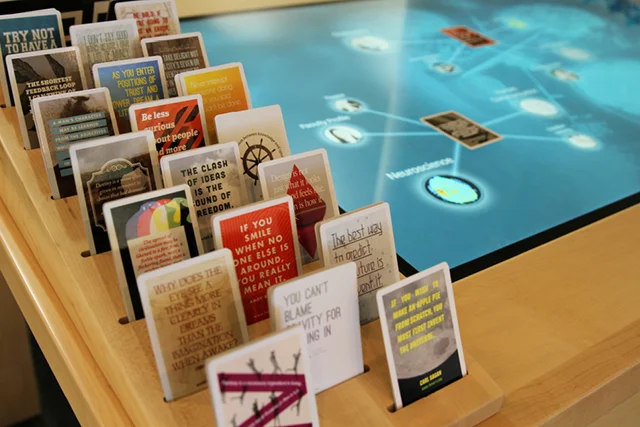
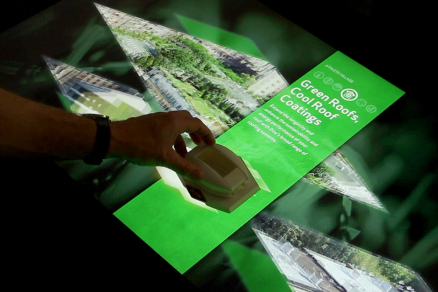
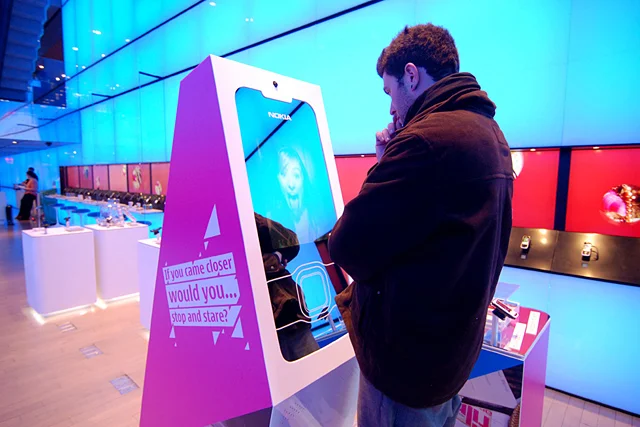
Each of the three Oracles that we built consist of a tabletop based projection with a high lumen projector mounted underneath, and a multi-user, multi-touch sensor system above. As visitors move their hands across the surface, Acura related graphics and symbols come to life with a flourish of activity and sound. Two interface elements allow visitors to control the experience. An inner slider / handle lets users select from four different categories of visuals: technology, connected, performance, and design. The two outermost sliders / handles, allow a user to control the color spectrum, from which the symbols will randomly select, when they generate themselves.
You must be logged in to post a comment.